From connection to dependence: Are new satellites solving the European digital divide or creating a new sovereignty problem?
By Dylan Browne-Wilkinson
Alife, a rural Italian town in the southern region of Campania, is situated at the base of the Matese Regional Park with mountains that rise over 2,000m on the horizon. Pietro Santillo lives in a house on the fringes of the small town located along a two kilometre dirt road, with the homes of ten other families spread widely apart from each other. Surrounded by pastures, Santillo works remotely full-time as a software developer. Yet, in this corner of Italy, and like many others, a reliable internet connection is never taken for granted.
As Italy rushed to connect as many communities across the country with fibre-optic cable during the first half of the 2020s, many inner and peripheral areas were deemed inaccessible and left off-grid. Around 1.8 million addresses, according to Infratel data, lie too far from any existing or planned fast network to be covered by 2028 without public money. Alife is located in a so-called ‘white zone,’ an area where no private operator had built or planned to build fixed broadband infrastructure before public intervention.
Recent government efforts to correct market failures in these areas have not borne fruit. In 2025, fibre was laid to Alife, as part of the Banda Ultra Larga (BUL) project to bridge the digital divide in southern Italy, but no operator took on the service contract due to lack of potential commercial returns. Santillo remembers how WindTre, an alternative Italian fixed wireless access (FWA) provider, was “completely unstable, with maximum speeds around 30 Mbps with frequent disconnections that would sometimes last hours.” An internet connection checkered with reliability issues has kept Santillo away from fixed-line providers ever since.
This falls into a larger self-reinforcing cycle. Without reliable networks, remote communities empty out and local commerce dries up, which in turn gives operators even less reason to invest in the infrastructure that might have kept them connected in the first place.
Consequently, residents have turned to a third way – low-earth orbit (LEO) satellite. In 2024, Santillo attached a pizza-sized satellite dish costing €250, for €29 a month (now €65). He recalls the difference: “it’s very rare that there are disconnections, the longest continuous downtime in recent years was 30 minutes during severe weather.”
The fix, however, didn’t come from Rome or Brussels, but rather from Starlink, an American company boasting a megaconstellation with over 11,000 LEO satellites owned by Elon Musk, who briefly became the world’s first trillionaire in mid-2026. As terrestrial rollout falls short, Santillo’s story illustrates why the government is now turning to a hybrid satellite-terrestrial network to reach the most remote homes and communities, and why this fix comes with a dependency of its own.
“Starlink? One possibility among others,” remarked Alessio Butti, Italy’s Undersecretary for Innovation in Giorgia Meloni’s government, in an interview with Il Sole 24 Ore in September 2025. That same month, the Italian government revealed a €145 million plan for a hybrid satellite-terrestrial coverage programme to recover its original connectivity goals. While existing fibre/terrestrial infrastructure would continue to serve areas with a well-established connection, satellites would be able to provide an additional connectivity layer to an estimated 120,000 premises in the most geographically challenging areas. This figure represents a fraction of Italy’s broader unconnected-address total, carved out specifically from premises the incumbent operator, Open Fiber, could no longer guarantee under the original fibre rollout.
Yet, rather than simply handing every remote household a dish and subscription to a private operator, Italy’s hybrid architecture would use the same constellation for ‘backhaul.’ Satellites carry data between a local network and the national internet backbone, replacing a fibre trunk line that would have otherwise been built. “The hybrid system integrates fibre/terrestrial and satellite, making it a seamless user experience,” explains Marcello Spagnulo, an aerospace engineer and technical advisor to Italy’s Interministerial Committee for Space and Aerospace Research Policies (COMINT). Spagnulo adds “the user’s device connects automatically to whichever network, terrestrial or satellite, is more efficient at that moment.”
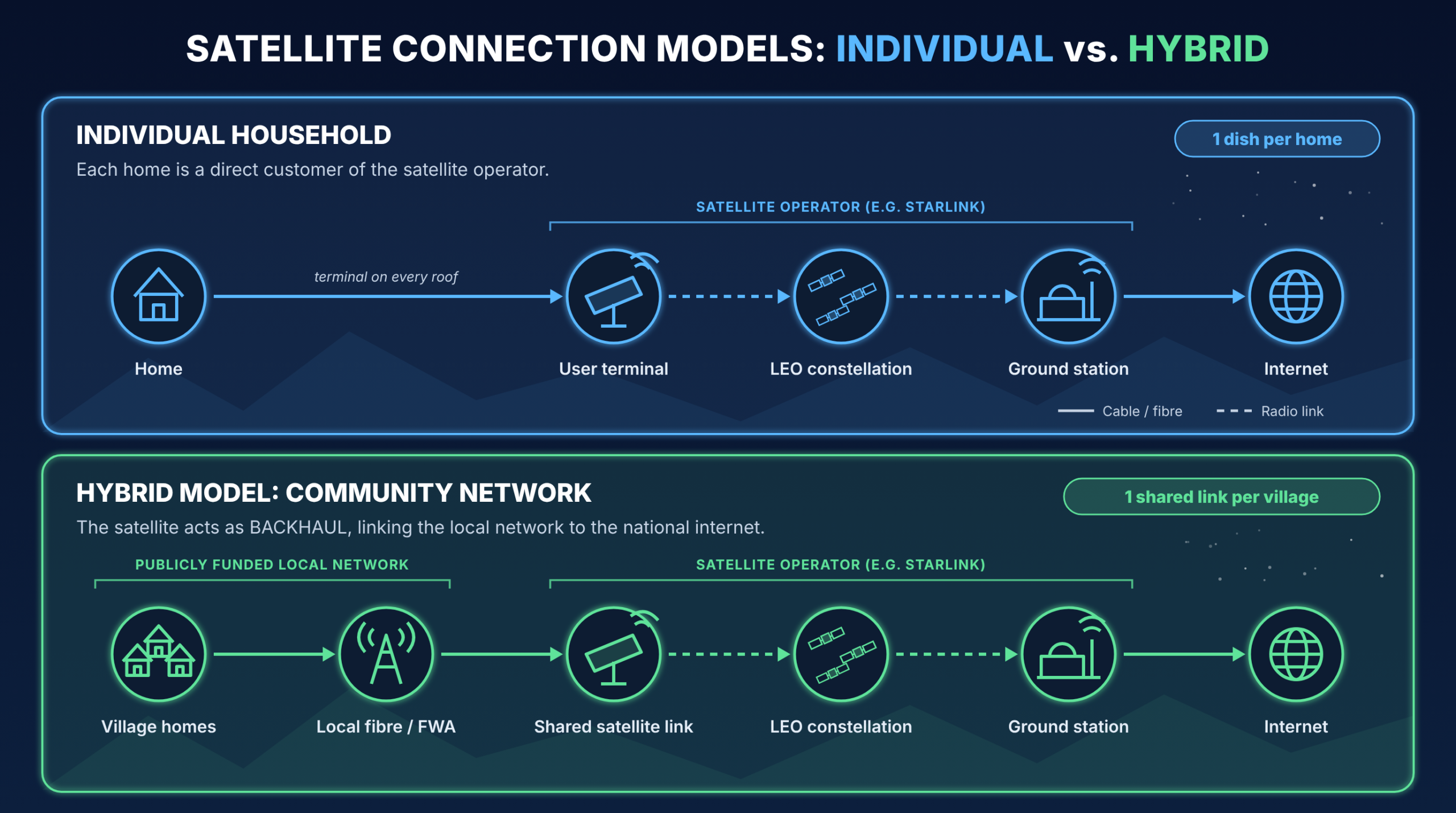
The rise of LEO satellites is tied to their operating altitude. Typically orbiting between 500-600km, they are about 60 times closer to earth compared to their geostationary earth orbiting (GEO) counterparts. “GEO satellites sit 36,000 km from the Earth’s surface,” explains Spagnulo, so even at the speed of light the signal takes long enough to be clearly noticeable in conversation. Conversely, the faster communication link of LEO satellites results in a micro-latency, so imperceptible that communication is almost fluid.
Incorporating satellites into a future hybrid model could break the market-failure loop observed in Italy for decades. Remote households and communities would finally connect to fast, reliable internet. Yet, a hybrid connectivity model that seamlessly integrates foreign, private providers into critical infrastructure has only been tested with one operator – Starlink, the same company already connecting Santillo privately, outside any state programme.
The Russia-Ukraine war brought the matter of dependency into focus. After Russia had targeted Ukraine’s terrestrial communications infrastructure in the early phases of the war, Starlink provided a lifeline for the Ukrainian forces. The network maintained communication between military bases and frontline forces whilst coordinating long-range drone attacks. But it also exposed a new vulnerability – a service with military significance was ultimately controlled by a private company.
“The war in Ukraine represented a turning point,” explains Valentina Chabert, a PhD fellow in International Law at Sapienza University of Rome. She points to Musk’s refusal to let Kyiv use Starlink in an operation to strike Russian forces in Crimea. The episode also exposed a wider shift in which satellites and space infrastructure had moved from the fringes of the national-security debate into critical infrastructure.
In October 2026, the question of who owns the switch became concrete. Days after Kyiv’s public dissatisfaction with Washington’s diesel deal with Moscow, Ukraine reported that Starlink terminals moving faster than about 160 km/h, in practice its attack drones, had been restricted without warning. Musk replied that the military system involved, Starshield, is controlled by the US government, which sets any limits. US President Donald Trump said he hadn’t ordered it, though Reuters reported that the order had come from the White House. The service was partly restored within days, but responsibility remains disputed. For Chabert, the entry of private actors creates “delicate questions of sovereignty,” particularly when states lack alternative providers and the commercial interests of a company diverge from those of the government relying on it.
Italy’s potential reliance on commercial LEO satellite constellations could raise a civilian infrastructure dependency. To assuage concerns about dependence, the government has emphasised “technology neutrality” in its procurement strategy, a process meaning that providers using Starlink can apply alongside those using other satellite systems. The principle matters because a state buying a strategic service needs a provider that “does not carry with it a political burden that would influence a country’s trajectory,” explains Chabert.
The Italian government may be able to negotiate guarantees with a private provider, but it cannot exercise the same direct control over a commercial constellation that it would over infrastructure it owns. Spagnulo points out that relying on an external provider creates a dependency regardless of whether the infrastructure is terrestrial or satellite-based. “It’s a problem that arises every time,” he says, with the available guarantees ultimately determined by what the government can negotiate. Italy’s terrestrial networks have been privately run since the 1990s, by companies such as TIM and Vodafone, but they compete with each other and answer to Italian regulators. Spagnulo warns against a particular vulnerability in the current LEO market: “the problem with Starlink today is that it’s a monopoly, it’s the only one.”
The sovereignty problem, therefore, centres on how a private provider could become indispensable in the face of a lack of alternatives, leaving a potential risk within the hybrid model. Chabert argues that a dominant private actor can, in such circumstances, condition a state’s trajectory by threatening to withdraw its service.
IRIS²
The EU's sovereign satellite constellation
- Budget€15.6 billion (raised in August 2026)
- Satellites348: 330 in low orbit, 18 in medium orbit
- Built bySpaceRISE: Eutelsat, SES and Hispasat, on a 12-year concession
- LaunchesFirst launches due in 2029
SATCOMBw Stage 4
Germany's "purely national, purely military" constellation
- CostUp to €10 billion (estimated)
- SatellitesAt least 100 (reported)
- ForSecure communications for Germany's armed forces worldwide
- ReadyInitial capability targeted for 2029
Europe’s answer to this dependency is IRIS² (Infrastructure for Resilience, Interconnectivity and Security by Satellite), adopted in March 2023. In December 2024, a public-private partnership was established between the European Commission and the SpaceRISE consortium, a group of three major European satellite operators Eutelsat, Hispasat and SES, supported by aerospace and telecoms subcontractors. The consortium won a twelve-year concession contract to design, deploy, and operate the programme.
As a sovereign programme, it exists to provide European governments, security forces, and emergency services a reliable connection with EU-owned satellites. “It is more accurate to think of IRIS² as a strategic infrastructure with civilian applications than a European equivalent of Starlink,” explains Stefano da Empoli, president of the Institute for Competitiveness (I-Com). He adds that “its primary function is to ensure a reliable connection even during a crisis or when terrestrial networks are unavailable.”
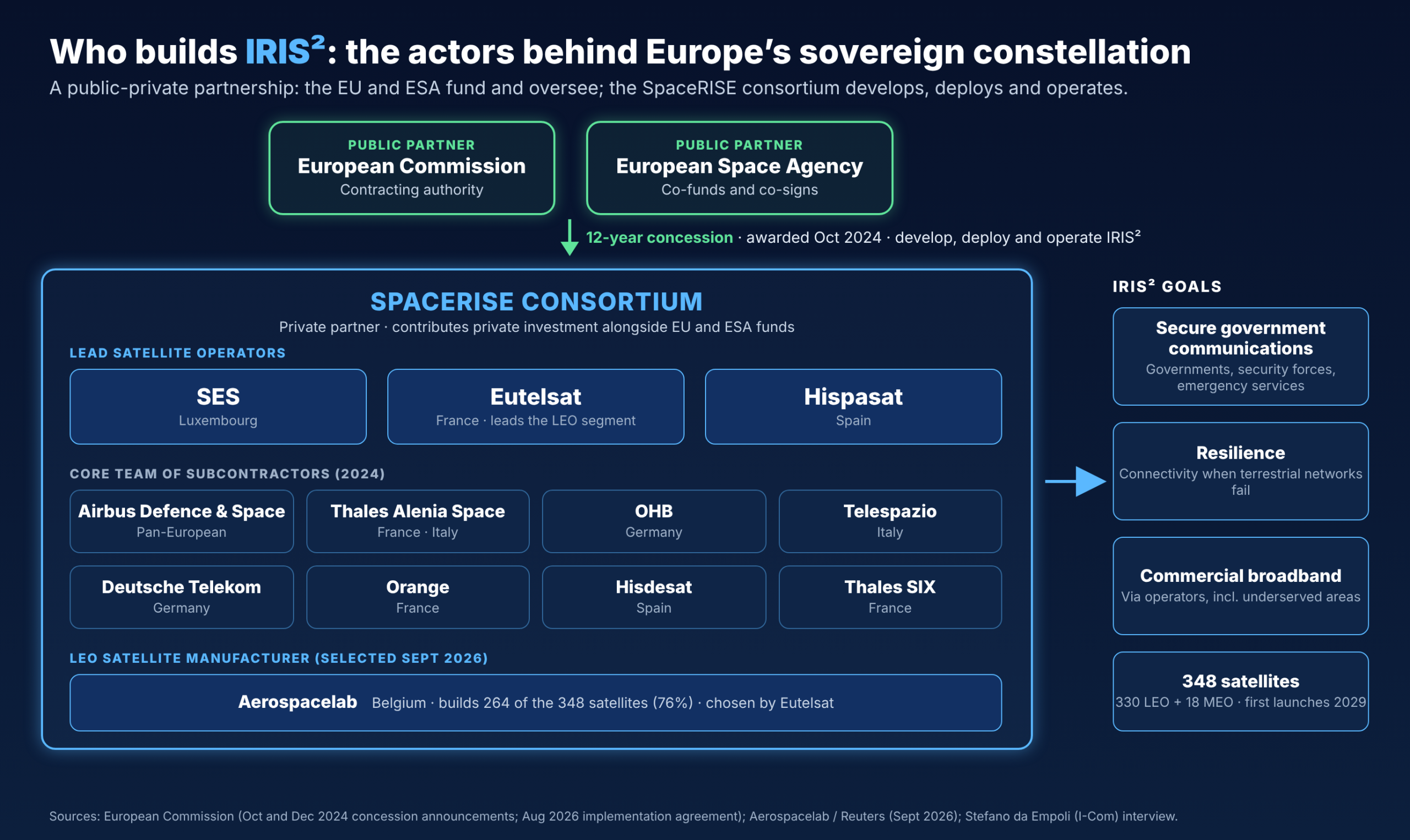
In August 2026, an implementation agreement signalled the project’s urgency. According to European Spaceflight, an independent European space industry news platform, the Commission increased the programme’s budget to €15.6 billion. The extra cost will come from EU budget resources for 2028–2034 and from member states, with Spain pledging €1.6–2 billion, Poland €656 million, and Hungary €500 million. Poland, which also pays for Ukraine’s Starlink subscriptions, is funding the sovereign alternative while depending on the service it is meant to replace. The additional 66 satellites are earmarked for defence, security and emergencies, expanding the constellation size to 348 spacecraft, of which 330 are low-orbit satellites. In an official statement by Andrius Kubilius, the European Commissioner for Defence Industry and Space, the revision “increases secure governmental capacity by more than 60% within the Union.”
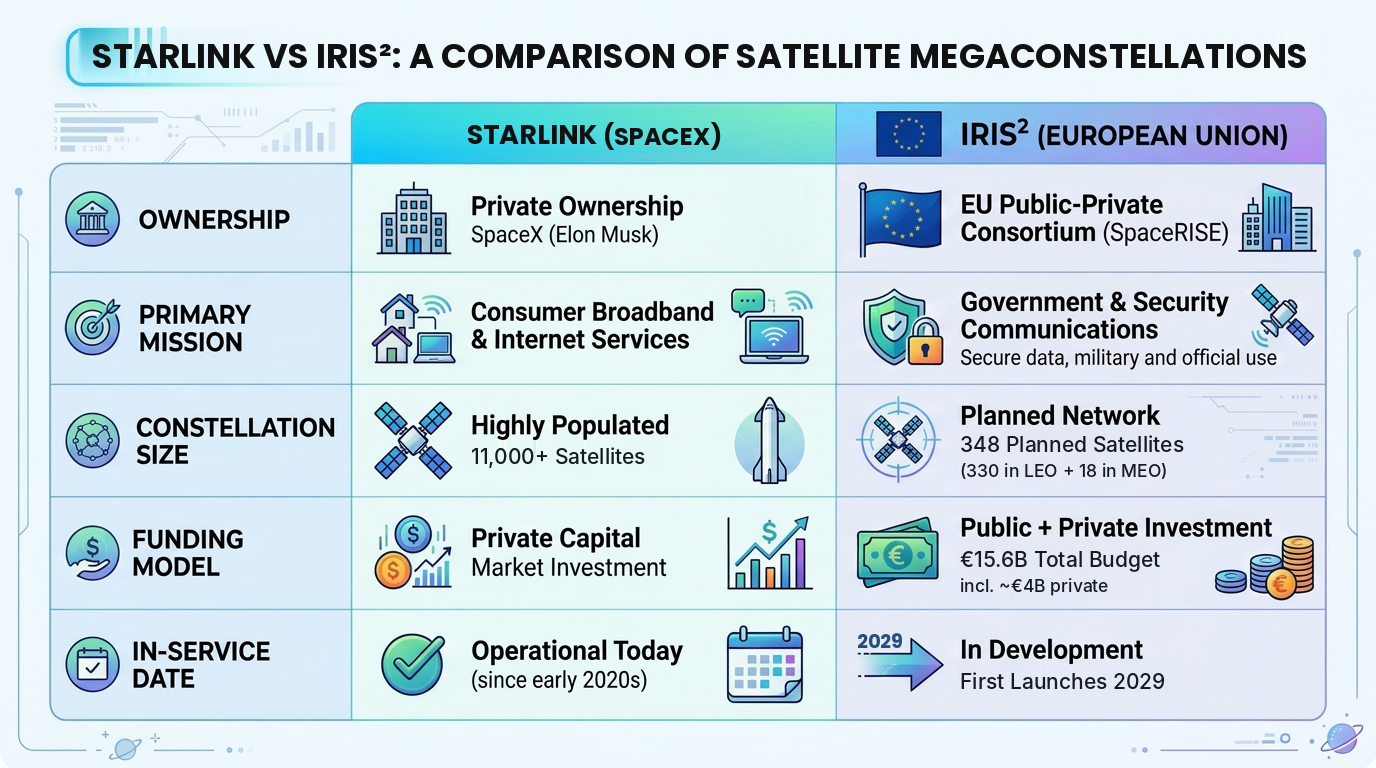
Da Empoli doesn’t put the spending increase down to Starlink’s success alone, pointing out that “the evolution of security needs matters more, in a geopolitical context that has changed very rapidly within just a few years.” IRIS² responds above all to a need that the market, on its own, has no obligation to meet – a resilient, secure communications capability over which Europe can exercise effective control.
While Brussels is building IRIS² as a collective project, Berlin is building its own. In September 2025, Germany’s military confirmed plans for a “purely national, purely military,” satellite constellation. Named SATCOMBw Stage 4, it will provide a secure, high-bandwidth network for Germany’s armed forces worldwide with reportedly at least 100 satellites. The initiative is estimated at up to €10 billion with initial operational capability targeted for 2029, part of a wider €35 billion investment in German space-defence capabilities through 2030.
The actors behind SpaceRISE may be part of the reason why Germany is pursuing its own alternative. Spagnulo points out that Europe’s operators “legitimately chose, in past years, to invest little – or only after some delay – in low-Earth-orbit constellations.” Eutelsat, a French operator and key IRIS² partner, moved into low orbit only in 2023, by merging with OneWeb, Europe’s largest LEO constellation. OneWeb had already needed rescuing when the UK government bought it out of bankruptcy in 2020. In 2025, France and the UK put a further €880 million into the combined group, yet with about 650 satellites OneWeb is dwarfed by Starlink’s 11,000.
IRIS² depends on companies that arrived late to the technology that Europe needs and its first launches are not due until 2029, with services phased in afterwards. Until it is ready, the gap has to be closed with what already exists. “Starlink can respond today to coverage and resilience needs for which an equally effective alternative doesn’t always exist,” says da Empoli.
In the meantime, Brussels is reaching for a quieter lever to reduce its dependency on American companies. Since 2009, Europe’s 2GHz band of radio frequencies which enables satellites to connect directly to mobile phones was contracted to two companies – Inmarsat and Solaris Mobile. Both were respectively bought by American companies Viasat and EchoStar, with the latter reportedly selling its global spectrum rights to SpaceX. With the European licences expiring in May 2027, Brussels wants to reserve most of the band for European operators. SpaceX has accused it of carving the band into “virtually unusable” parts. Whether Europe can fill the space it is clearing is another question.
Marcello Spagnulo, aerospace engineer and technical advisor to Italy’s Interministerial Committee for Space and Aerospace Research Policies, on who will control Europe’s 2 GHz band, and whether its operators are ready.
For Santillo, and for Italy, the sovereign option will arrive after the dependency has set in.
The dependency and the response to it both put more hardware into orbit. According to data tracked by astrophysicist Jonathan McDowell in Jonathan’s Space Report, there was a ninefold increase in launched payloads between 2019 and 2025, from 500 to 4,526. Starlink is the main driver behind the recent boom. In 2019, its launches represented about 24% of the global total (120); in 2025, about 70% (3,169).
Reusable rockets and the miniaturisation of satellite technology into microsatellites made that scale possible. In January 2021, SpaceX, the private aerospace company that owns Starlink, set a record by launching 143 payloads on a single rideshare mission, according to BBC News, a feat that demonstrated how far the cost of reaching orbit had fallen. “In the past, ‘Space’ was the exclusive domain of sovereign states,” remarks Frediano Finucci, head of the economic and foreign affairs desk at TG La7 News. “Now, instead, we are talking about a small group of companies, with SpaceX in the lead, offering solutions that States and armies either don’t have or don’t want to manage directly.”
Governance has not kept pace with the rapidly evolving space sector. Finucci is blunt: “there is no real and effective governance in space.” “In space there are no traffic lights, no speed cameras, and no traffic police or surveillance cameras.” The only body he knows of is a “kind of United Nations register of Space objects,” a record of who launched what, which depends on self-reporting. States, he says, often ignore its rules, especially for spy satellites.
Europe is trying to write some rules of its own. The EU Space Act, proposed by the Commission in June 2025, would set common requirements on safety, resilience and space debris for any operator serving the European market, including non-EU companies such as Starlink. It is still being negotiated, however, and Washington has formally objected.
An international framework still rests on the 1967 Outer Space Treaty, negotiated by the United Nations and joined by 118 states. Nothing in the treaty limits how many satellites a company may launch, and the rules on how they end are voluntary or shift the responsibility to the state where payloads were launched.
According to Jonathan’s Space Report, 1,823 of the roughly 13,000 Starlink satellites launched since 2019 have decayed by 30 September 2026, including 43% of those launched in 2021. A Starlink satellite is designed to last about five years, so keeping roughly 11,000 in service implies replacing around 2,000 a year. The same applies to any low-orbit constellation, including IRIS²’s 330 low-orbit satellites. In low orbit, sovereignty is a recurring cost, not a one-off purchase.
A decommissioned satellite is disposed of by burning up in the Earth’s high atmosphere during a controlled reentry. However, the materials don’t disappear, vaporising into tiny metallic vapours and smoke particles that remain suspended high above Earth. A 2025 modelling study led by Chris Maloney, a research scientist at the US-based National Oceanic and Atmospheric Administration, asked what happens at scale. If the roughly 60,000 low-orbit satellites projected by 2040 are reached, as predicted by the U.S. Government Accountability Office in 2022, “we might actually start influencing the middle atmosphere,” Maloney says.
Some costs are already visible from the ground. Satellite trails are damaging astronomers’ work, Finucci says, and he knows of no serious initiative to stop it: “the astronomers’ lobby is perhaps not powerful enough, unfortunately.” Those who study the sky have little say over how it is filled. That is decided by the companies launching satellites, and by those buying their services. Among them is Italy’s high-speed rail operator Italo.
Onboard speed test
Starlink on an Italo train, test results reported by La Repubblica
With 143 passengers connected: about ten times the standard trackside connection, enough for nearly 40 HD video streams at once.
Italo × Starlink
High-speed rail, connected from orbit
- SinceFebruary 2026: the world's first major train company to roll out Starlink fleet-wide, free for passengers
- Fleet51 trains; more than half fitted by September 2026
- CompleteFull rollout due by spring 2027
- TunnelsA Nomad Digital system switches automatically to 5G where there's no sky view
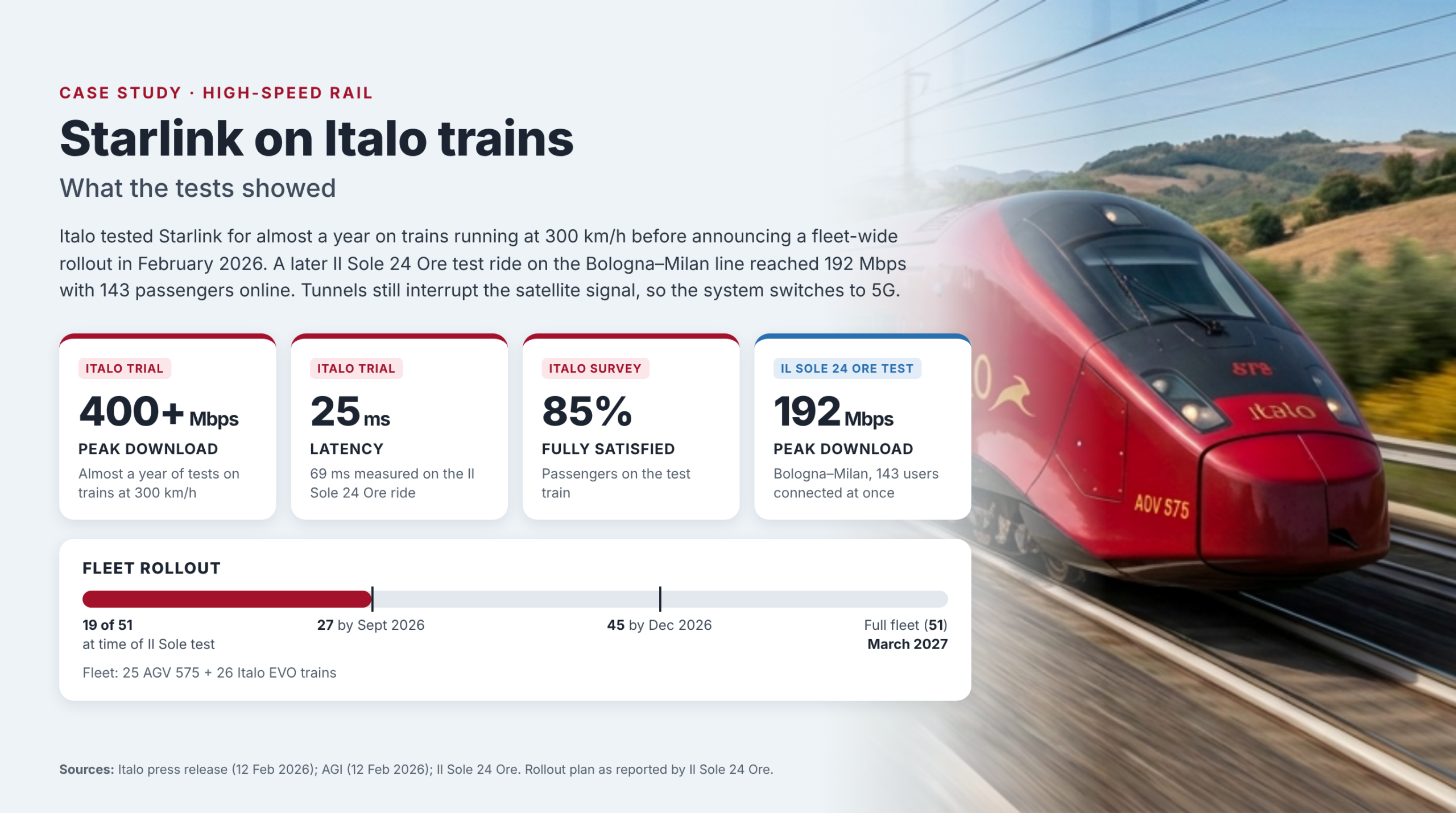
In February 2026, Italo became the world’s first major train company to roll out Starlink fleet-wide, offering it to passengers free of charge. By September 2026, more than half the 51-train fleet had been fitted, with full rollout due by March 2027.
According to La Repubblica, an Italian national daily newspaper, testing results showed that the download speed using Starlink averaged 192 Mbps with 143 passengers connected, about ten times faster than standard trackside connection and enough for nearly 40 simultaneous 1080p HD video streams. In addition, ping time, the total time it takes to send and receive data, fell to 25 milliseconds, a near-instant response. Tunnels and mountains still interrupt the satellite signal, so a system from Nomad Digital, a British provider for train digital connectivity, switches automatically between 5G in tunnels and satellite in open country. In effect, Italo’s hybrid network parallels the government’s model for remote communities that hands passengers between terrestrial and satellite links without them noticing.
While Italo’s contract is small, it is one of many in a recent wave of business customers drawn by Starlink’s Priority plan. It guarantees 99.9% network availability each month and credits 20% of the monthly fee if downtime exceeds 45 minutes. SpaceX’s 2026 IPO filing showed how the business is paying off as Starlink earned $11.4 billion in revenue in 2025, up 50% on the year before, and $4.4 billion in operating income. Every new customer adds revenue to the provider that already has the scale, and that revenue pays for the launches that expand the constellation.
How a high-speed train stays online: the carriage connects to a low-Earth-orbit satellite in open country, then switches automatically to 5G repeaters on the tunnel ceiling when the sky is out of view, so passengers’ sessions continue without a break.
As Starlink quickly consolidates its position in the new space economy, Spagnulo’s warning that Starlink is “the only one” raises a legal question. “A dominant position […] is not in itself unlawful,” explains da Empoli, but anticompetitive practices must first emerge such as “agreements that foreclose the market, exclusionary conditions, or abuse of a dominant position.” Since Starlink spans many different sectors such as households, government, and transport, defining the relevant market, a crucial first step to identifying misconduct, is difficult. Da Empoli points out that while “antitrust therefore remains necessary, […] it can’t substitute for effective ex-ante regulation and an EU-level industrial policy that helps build European capacity,” achieved by combining both public and private capital and adding innovation as a key ingredient.
While the Italian government’s hybrid programme will be scrutinised through consultation and procurement, Italo’s dependency rests on a commercial contract that was signed without public debate. Da Empoli doesn’t think a private contract should face the rules of a public tender simply because the supplier is foreign, but he argues that security, data protection and the terms for changing providers deserve the closest scrutiny. Once antennas are built into the Siemens trains Italo has ordered for German market expansion in 2028, switching suppliers stops being a paperwork exercise.
What Italo has done along the tracks, airlines are now doing at 10,000 metres, with one difference – they have a second supplier to choose from, and it is also American. Amazon Leo, the satellite arm of Jeff Bezos’s Amazon, has entered the satellite internet market, with an existing 399 satellites and approval to grow to about 7,700 over the next decade.
US-based JetBlue Airways and Delta Air Lines publicly announced deals with Amazon Leo to support in-flight connectivity with rollouts expected to start towards the end of 2027 and beginning of 2028. Meanwhile, European carriers have so far gone with Starlink, among them the Lufthansa Group and the International Airlines Group (IAG) that includes British Airways and Iberia.
“Two US companies reduce dependence on a single firm,” says da Empoli, “but naturally don’t eliminate Europe’s dependence on non-European capability,” although he adds that competition, including over the security guarantees they offer customers, could reduce the risk.
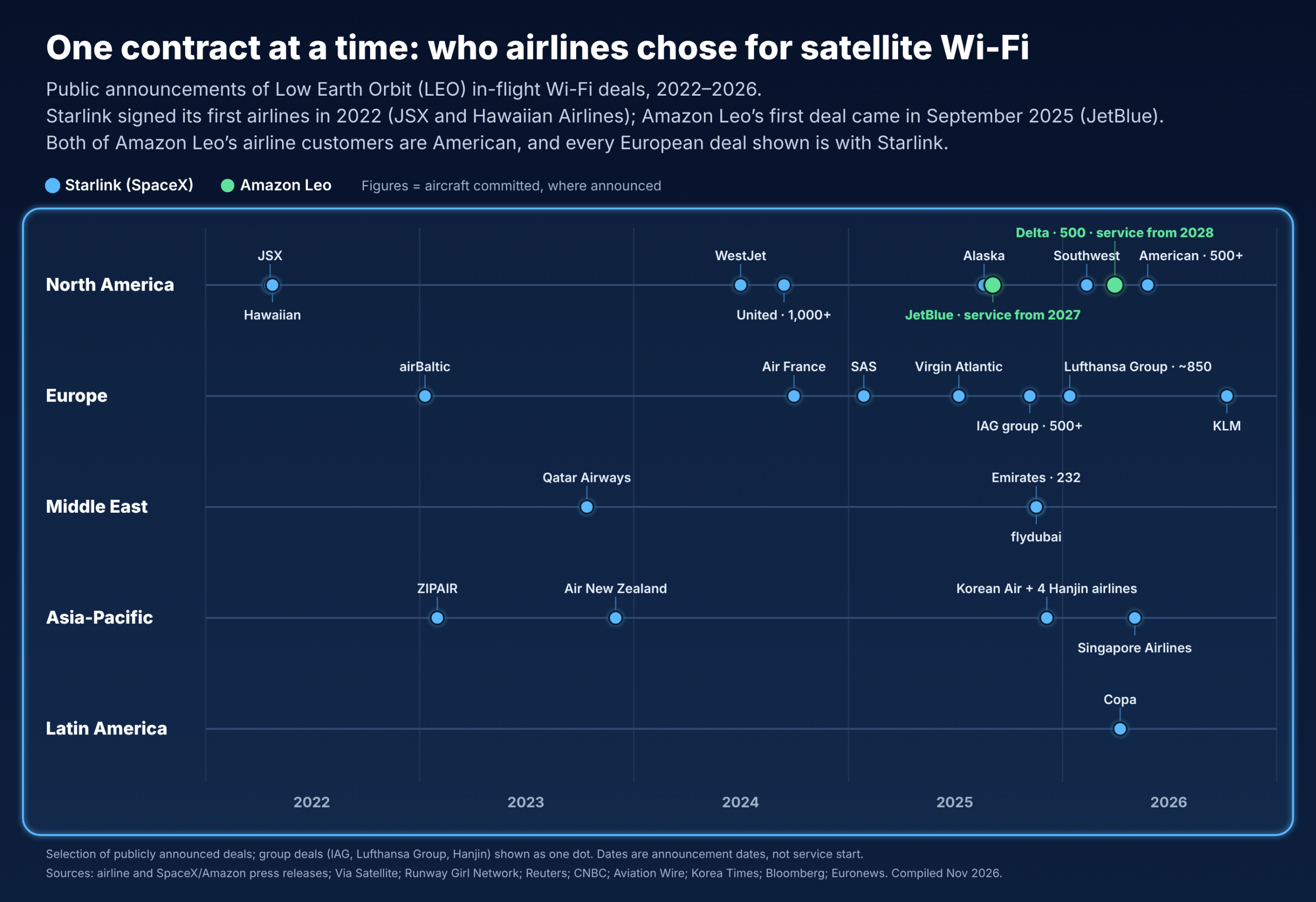
The catch is switching. “Installing equipment across an entire fleet requires investment and time,” he says, so having two suppliers on the market doesn’t automatically mean that an airline can easily switch from one to another. According to The Tech Buzz, an Amazon Leo refit costs $267,000-$445,000 (€237,600-€396,000) per aircraft, and Starlink’s aviation antenna kit costs around $200,000 (€177,980). Switching in either direction means paying that again across a whole fleet.
For Chabert, the question of dependency lies in who the providers are. Starlink and Amazon are headquartered in the allied United States, part of the same Euro-Atlantic alliance. In her view, “the problem concerns more the protection of personal data collected by such companies” than any threat to national security. It would be a different matter, she says, had airlines chosen a Chinese or Russian provider such as Huawei. October’s events in Ukraine complicate that view as the speed restriction was blamed not on Moscow or Beijing, but on Washington.
Among Europe’s alternatives, Eutelsat’s OneWeb has so far not landed airline deals on Starlink’s scale. In addition, da Empoli warns that it would be unwise to promise IRIS² will solve connectivity on board transport vehicles any time soon. In the future, he says, an airline could buy an IRIS²-based service “if performance, coverage, and price were suitable.” For the next several years, it cannot. Two suppliers give airlines more choice on paper than in practice, and both are American. For now, the decision rests with individual carriers, one contract at a time.
A household in Campania, the Italian government, rail operators and international airlines have all followed the same pattern. The connection came first, and the question of who controls it came later. Satellites are closing gaps that fibre could not reach, quickly and effectively. But as they become baked into the solution, the question shifts from whether people can be connected to who controls the infrastructure that connects them.
Governance has struggled to keep up, and Chabert does not expect that to change. “International regulation requires lengthy negotiations and the consensus of numerous States,” she says, “while technological development can happen within a few years or even months.” The rules were written for a time when space belonged to governments, while today’s new space economy is increasingly characterised by private companies that serve both civilian and military users. Problems such as orbital congestion, interference and reliance on private operators tend to become visible only after the technology has spread.
In her view, the gap is structural as it can be narrowed through technical standards and closer cooperation between public and private actors, but hardly closed. Finucci frames the outcome as an open question between companies and states, one Ukraine confronted in October: “who controls whom?”
For Spagnulo, competition is the cure. Once other low-orbit operators arrive, he says, the monopoly problem “could fade away.” Amazon Leo is building a constellation that hopes to rival Starlink’s market position, while IRIS² is due to begin launching in 2029, and wealthy nation-states like Germany are planning a national military network of their own. Da Empoli argues that Europe’s part is an industrial policy that builds its own capacity, rather than relying on competition law alone. Meanwhile, Finucci points to new companies offering countries “turnkey” constellations they can run themselves, with sovereignty staying in the buyer’s hands.
Yet Italo and the airlines point to a problem of timing. Every alternative arrives in a market where antennas are already installed and contracts already signed. Italo’s trains, Delta’s aircraft and the villages in Italy’s hybrid programme will not switch easily because a new option exists. The longer Europe waits, the more expensive its sovereignty becomes.
Pietro Santillo’s connection works, and nothing suggests he should give it up. On a dirt road outside Alife, Starlink did what Rome and Brussels could not. For Santillo, a fast, affordable connection today outweighs the risk of depending on one company tomorrow. The question is whether Italy, and Europe, can afford to make the same calculation.